
The brief was simple and common: a sales team with a defined, narrow market — one industry, one region — whose usual lead sources had dried up. Directory exports. Old trade-show lists. The kind of "leads" that cost a rep twenty minutes of research before the first call is even worth making.
What I built instead was a single ranked list, one row per real business, each one carrying everything a rep needs to make that first call a good one: a fit score, a direct contact where one could actually be found, and a short, specific reason to pick up the phone — not a form-letter opener.
What a researched lead actually looks like
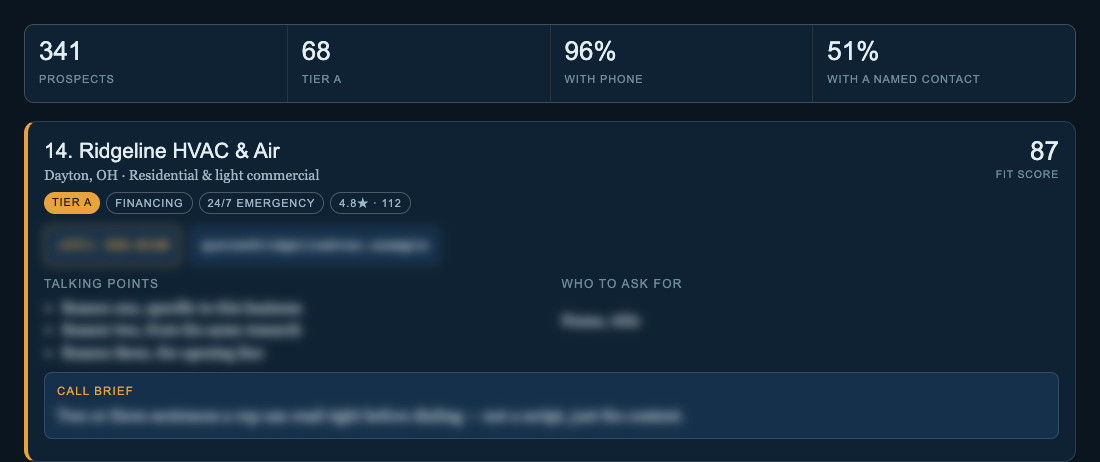
This is a mocked-up example, not the real client's data — same shape, fabricated business — because the real list isn't mine to show. But it's an honest picture of what shows up per prospect: a fit score, the signals that drove it, a direct contact where one exists, and a few specific reasons to call, not a generic pitch.
What you see before you buy
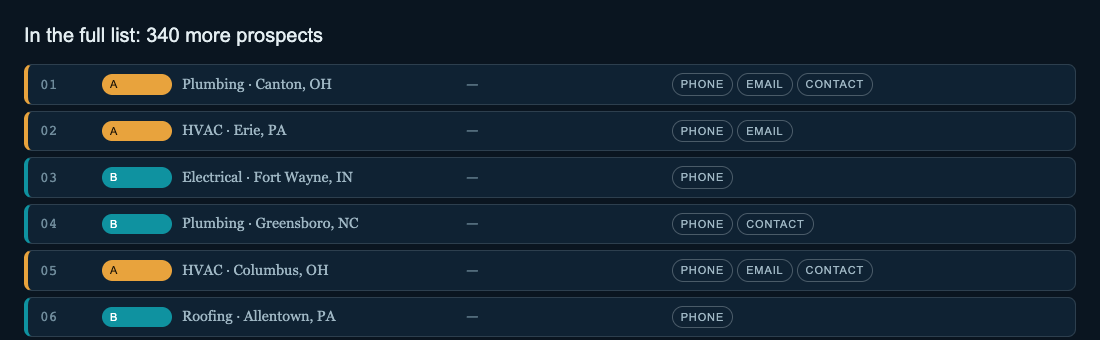
The full list is ranked top to bottom, but it isn't handed over all at once, unqualified. A sample tier comes fully unlocked — real contacts, real research — so you can judge the quality before committing to the rest. Everything past that shows its rank, its tier, and what's available on it, with the specifics held back until it's actually yours.
What I won't put in a blog post
Every list is researched and ranked against the signals that actually predict fit for that client's pitch — and that mix is different every time, because the businesses worth calling in one market aren't the same ones worth calling in another. Figuring out which signals matter, where to source them, and how to verify a contact is real before it goes on the list is most of the actual work. That part I keep for the people who hire me, the same way I would for you.
What I can tell you: it's built from research a rep could do themselves, just not for 300 businesses before lunch. Every phone number and email gets checked against the business's own site before it makes the list — nothing gets on there because a database said so.
A list of names isn't a pipeline. A list of reasons to call is.