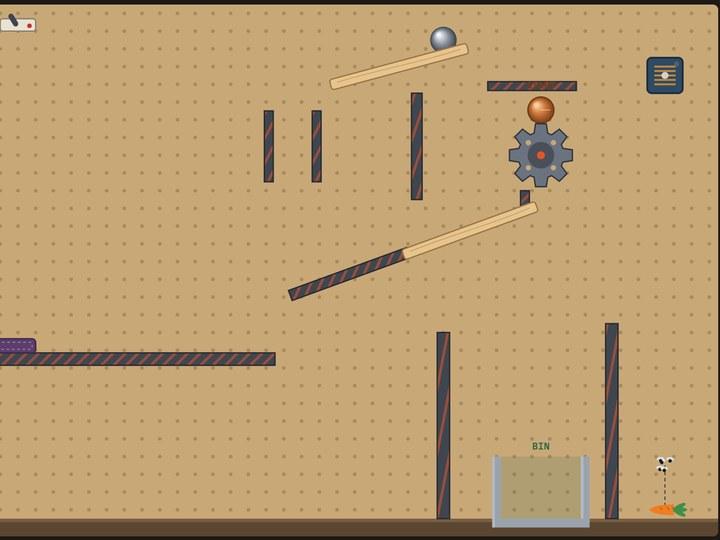
My kids found an old computer of mine and started playing games on it. That was fine for about a day. Then I noticed what the games actually were: tap here, collect that, watch a reward animation, repeat. They were having fun, but nobody was thinking.
It reminded me of a computer game from the early 1990s, The Incredible Machine. You got a puzzle, a handful of parts like ramps, balls, belts, and fans, and a goal. You built a contraption, hit start, and watched it work, or more often watched it fail in some ridiculous way. Then you fixed it and tried again. It was a game, but it was also basically physics and engineering in disguise.
I wanted my kids to have something like that. So I built one. It’s called Knock-On, it runs in any web browser, and it’s free.
How it plays
Every puzzle is a pegboard with a copper ball, a bin, and a few things already bolted in place. You get a drawer of parts. Pick one, tap the board to place it, tilt it if you need to, and press Run. If the ball ends up in the bin, you solved it.
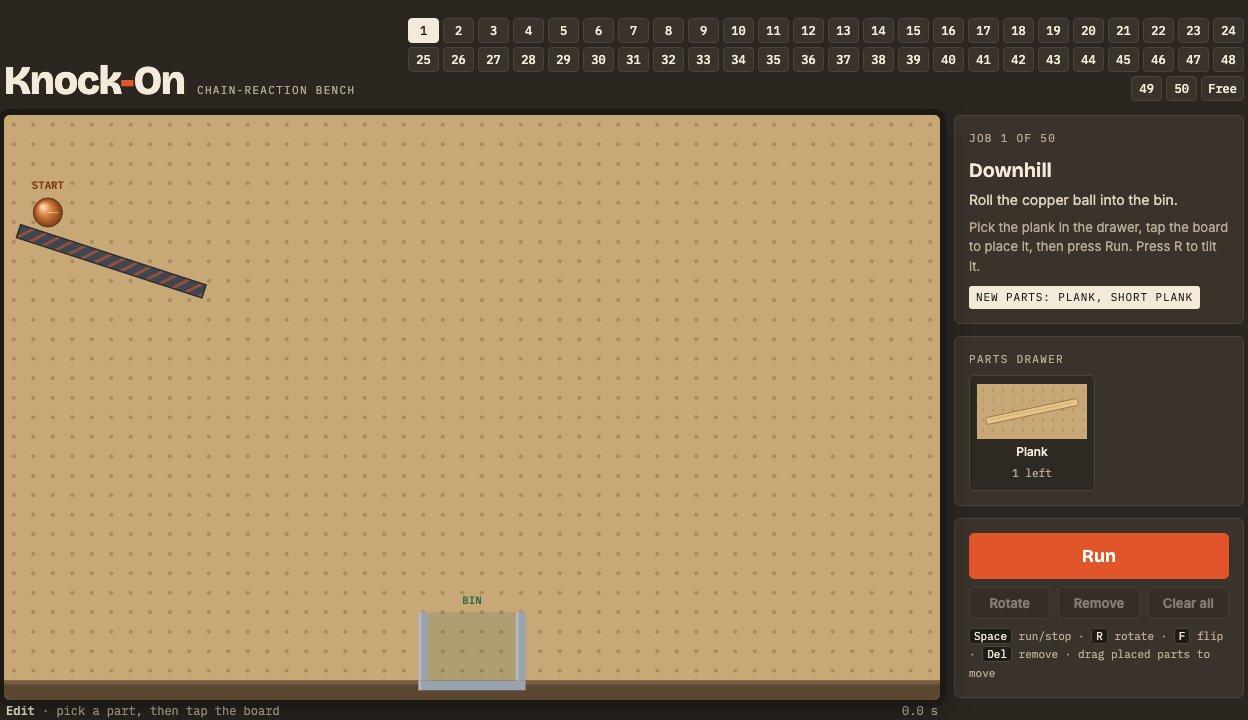
The early puzzles are about the basics: planks, trampolines, blowers, conveyor belts, seesaws, dominoes, magnets that only pull steel balls, balloons that lift whatever they’re tied to. The second half adds cause and effect. A light switch turns on the power for the whole board. A lit bulb attracts flies, which will tow a ball if you’ve tied them to it. A rabbit on a bike pedals toward any carrot it can see and pushes whatever’s in the way. A motor turns gears, and gears turn each other. There’s a cannon, too, because of course there is.
By the last puzzle, The Grand Machine, you’re firing the cannon, starting the gears, lighting the bulb, and feeding the rabbit, all to drop one ball into one bin.
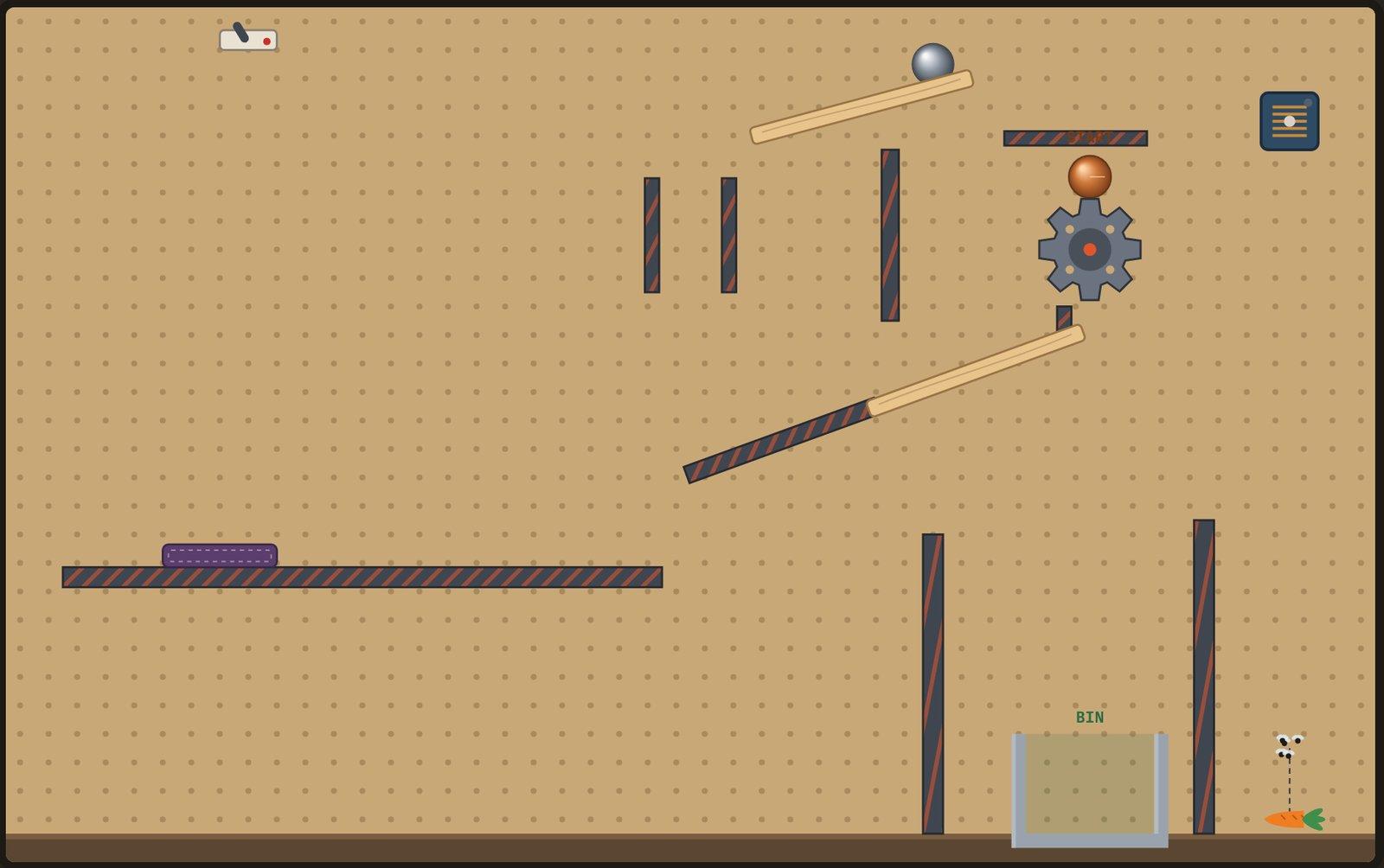
There’s also a Free Build mode with every part and no goal, for when someone just wants to make a mess.
Why this kind of game
The loop is what I like about it. You look at the board, make a guess about what will happen, and then you find out. Usually your guess is a little wrong. The ball bounces too far, or the domino falls the other way. So you adjust and run it again.
- 01LookWhat’s on the board, what’s in the drawer
- 02GuessWhere the ball will go
- 03RunWatch the chain reaction
- 04See where it brokeToo far, too short, wrong way
- 05AdjustMove one thing and try again
That’s the same loop as a science experiment, or debugging code, or fixing anything. And failing doesn’t feel like losing, because you can watch exactly where it went wrong. There are no timers, no lives, no ads, and nothing to buy.
Making 50 puzzles fair
The hardest part of building it wasn’t the physics. It was making the puzzles get harder in a way that feels fair instead of frustrating.
A few rules came out of that. Every new part gets its own puzzle that teaches it before it shows up anywhere else, so nobody gets ambushed by a rabbit they’ve never seen. In the second half, puzzles get harder by making the chain longer, with more things that have to happen in order, not by stuffing the drawer with decoy parts. A drawer full of junk you don’t need doesn’t make you think harder. It just makes you guess more.
Physics games also have a sneaky problem: a small change to how something bounces can quietly break a puzzle that used to work. So every puzzle has a known solution saved, and an automatic check runs all 50 of them to confirm two things: each puzzle can still be solved, and none of them solves itself if you just press Run.
I also wrote a solver that searches for solutions on its own, which was humbling. It kept finding shortcuts I hadn’t intended, like using a trampoline as a skeleton key for half the puzzles. Each time it did, I either fixed the puzzle or took the trampoline out of that drawer. Kids are even better at finding shortcuts than solvers, so I’m sure there are more.
Inspired by, not a copy
Knock-On borrows the idea of The Incredible Machine, not the game itself. The parts, puzzles, and look are all its own. The pegboard-and-workbench style is meant to feel like tinkering in a garage. The physics runs on an open-source engine called Matter.js, and there’s no AI in the game at all. It doesn’t need any.
Try it
It’s at knockon.36dunes.com. No sign-up, no download. The first few puzzles take a minute. The last few might take an evening. If you’ve got kids who like building things, or you remember the original, give it a try.
I’d love to hear which puzzle got you stuck, or what part you’d want added next.
The best part of a chain-reaction puzzle is watching it go wrong, because then you know what to fix.